

Every warehouse needs pallet jacks. But with manual, electric, rough terrain, and high-lift variants available, selecting the right type matters for productivity, budget, and worker safety.
For complementary material handling equipment, see ZEOU material handling carts.
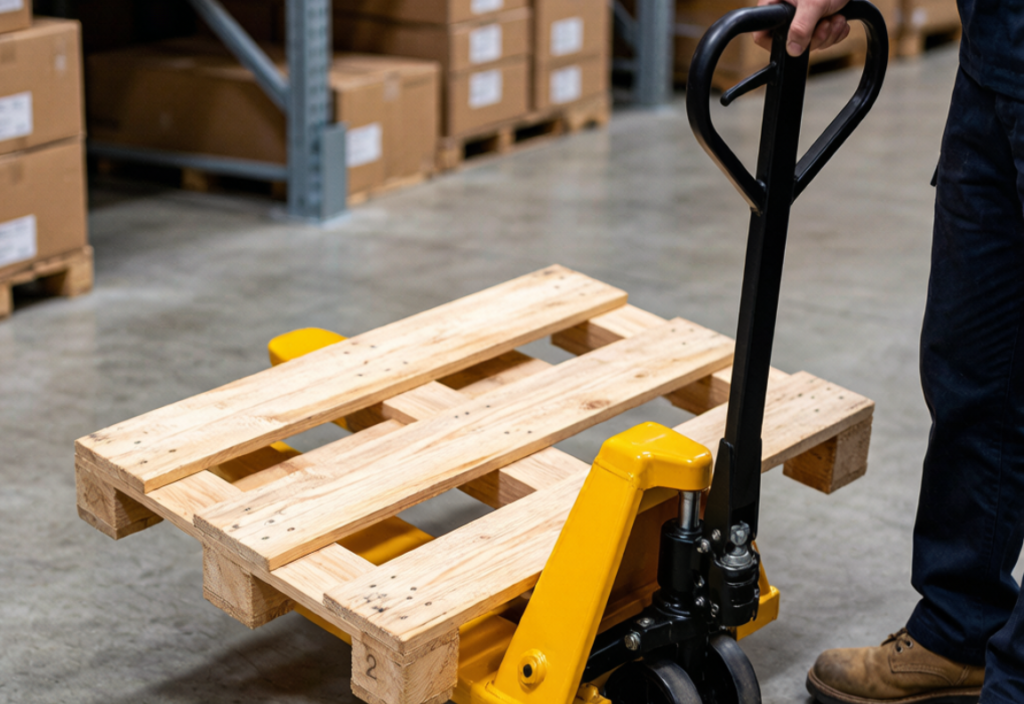
Pallet Jack Overview
Pallet jacks (also called pallet trucks) are the most basic and widely used material handling equipment. They lift pallets just enough (3-6 inches) to clear the floor for transport. Despite their simplicity, they handle millions of pallet moves daily in warehouses worldwide.
The OSHA standard for powered industrial trucks (1910.178) applies to electric pallet jacks, requiring operator training and daily safety inspections.
Manual Pallet Jacks
Most common material handling tool: Manual pallet jacks are found in virtually every warehouse. They use a hydraulic hand-pump system — pumping the handle raises the forks 3-4 inches. Releasing the control valve lowers them. No battery, no motor, minimal maintenance.
Capacities: 4,500-5,500 lbs standard. Fork lengths: 36-72 inches. Wheels: Dual polyurethane load wheels, single or dual steer wheels. Best for: Low-volume operations, short-distance moves, loading/unloading trucks, retail backrooms. Cost: $200-500.
Electric Pallet Jacks
Electric pallet jacks (also called powered pallet trucks or walkie riders) use a battery-powered motor for both lifting and propulsion. The operator walks behind or rides on the unit, controlling speed and direction with a tiller arm.
Capacities: 4,000-12,000 lbs. Battery life: 4-8 hours per charge. Speed: 2-5 mph. Best for: High-volume operations, long-distance moves (>100 ft), cross-docking, truck loading. Cost: $2,000-10,000.
Productivity comparison: Manual pallet jacks move roughly 10-15 pallets per hour per operator. Electric pallet jacks move 25-40 pallets per hour — a 2-3x productivity improvement. For operations moving 100+ pallets daily, electric jacks typically pay for themselves in 6-12 months.
Rough Terrain Pallet Trucks
Rough terrain pallet trucks feature large pneumatic wheels (10-16 inches), higher ground clearance, and reinforced frames. They operate on gravel, dirt, grass, mud, and uneven surfaces where standard pallet jacks cannot function.
Capacities: 5,000-10,000 lbs. Wheels: Pneumatic or solid rubber (10-16 inch). Best for: Construction sites, lumber yards, farms, equipment rental yards, outdoor material storage. Cost: $800-3,000.
High-Lift Pallet Jacks
High-lift pallet jacks (pallet stackers) lift pallets to working height (typically 30-60 inches), allowing the operator to work at waist level without bending. Some models reach 130+ inches for light stacking.
Capacities: 2,200-4,400 lbs. Lift height: 30-63 inches (standard), up to 130 inches (stacker models).
Type Comparison Table
| Type | Capacity | Cost | Speed | Best For |
|---|---|---|---|---|
| Manual | 4,500-5,500 lbs | $200-500 | Slow | Low volume, short distance |
| Electric walkie | 4,000-6,000 lbs | $2,000-5,000 | Moderate | Medium-high volume |
| Electric rider | 6,000-12,000 lbs | $5,000-10,000 | Fast | High volume, long distance |
| Rough terrain | 5,000-10,000 lbs | $800-3,000 | Moderate | Outdoor, uneven surfaces |
| High-lift | 2,200-4,400 lbs | $1,500-5,000 | Moderate | Ergonomic work positioning |
Fork Lengths & Configurations
Standard fork lengths: 36″ (half-pallet), 42″ (Euro pallet), 48″ (GMA standard — most common), 60″ and 72″ (long pallets). Fork width: 20.5″ (standard), 27″ (wide, for double pallets). Special configurations: Adjustable forks, single fork (luggage/handling), scale-equipped (weighing), and stainless steel (food/pharma).
Electric Pallet Jack Battery Guide
Lead-acid: Lower cost, requires regular maintenance (water topping), 8-10 hour charge time, 1,500-cycle life. Lithium-ion: Higher cost, maintenance-free, 2-3 hour charge time, 3,000+ cycle life, better cold performance. For high-use applications requiring multi-shift operation, lithium-ion’s fast charging eliminates the need for spare battery swap.
FAQ
Manual vs electric pallet jack?
Manual = pump handle, $200-500, slow. Electric = battery powered, $2,000-10,000, 2-3x faster.
Typical load capacity?
4,500-12,000 lbs depending on type. Standard manual: 4,500-5,500 lbs.
Common fork lengths?
48 inches (most common). Also 36, 42, 60, 72 inches.
Electric battery life?
4-8 hours per charge. Lithium charges in 2-3 hours vs 8-10 for lead-acid.
Best for rough terrain?
Rough terrain pallet trucks with large pneumatic wheels (10-16 inch).
Conclusion
Pallet jacks are essential to nearly every warehouse operation. Manual jacks offer the lowest cost and simplest operation for low-volume use. Electric jacks provide 2-3x productivity gains for higher-volume operations. Rough terrain and high-lift variants extend the pallet jack concept to applications that standard models cannot address. Choose based on your volume, distance, floor surface, and budget.
