

When planning a new warehouse or reconfiguring an existing one, the choice between selective pallet racking and drive-in racking is often the first and most consequential decision. Get it right, and you maximize both storage capacity and operational efficiency. Get it wrong, and you may waste space or create operational bottlenecks.
This comparison helps you decide based on your specific inventory profile. For complementary wire shelving solutions, see ZEOU wire shelving products.
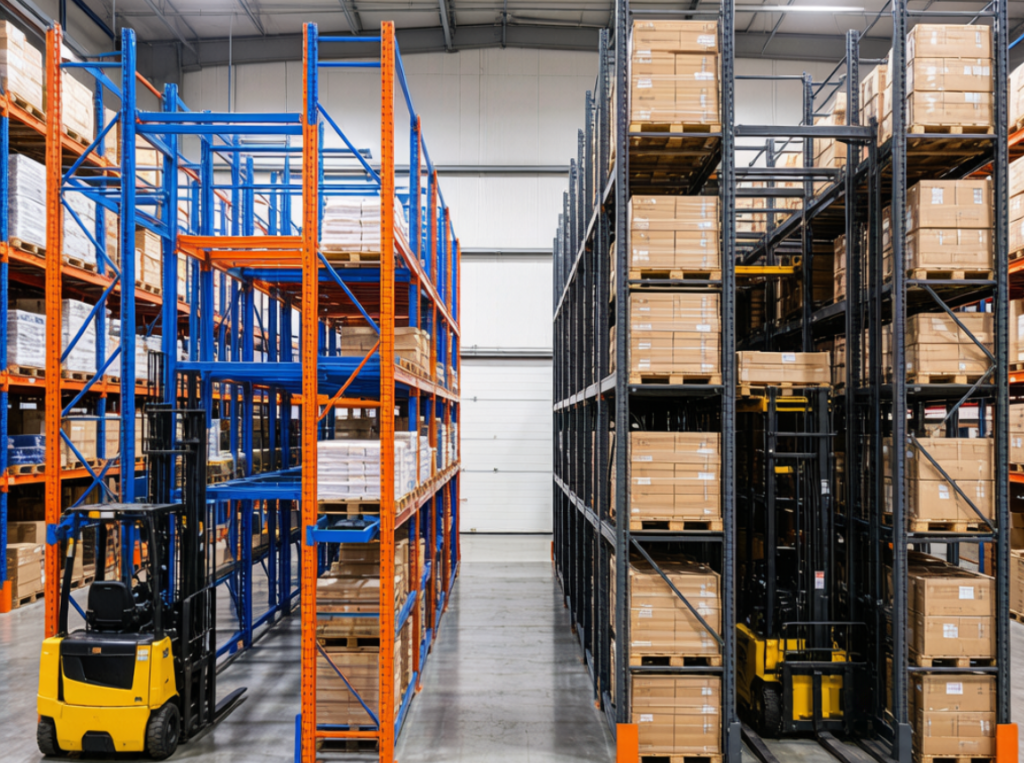
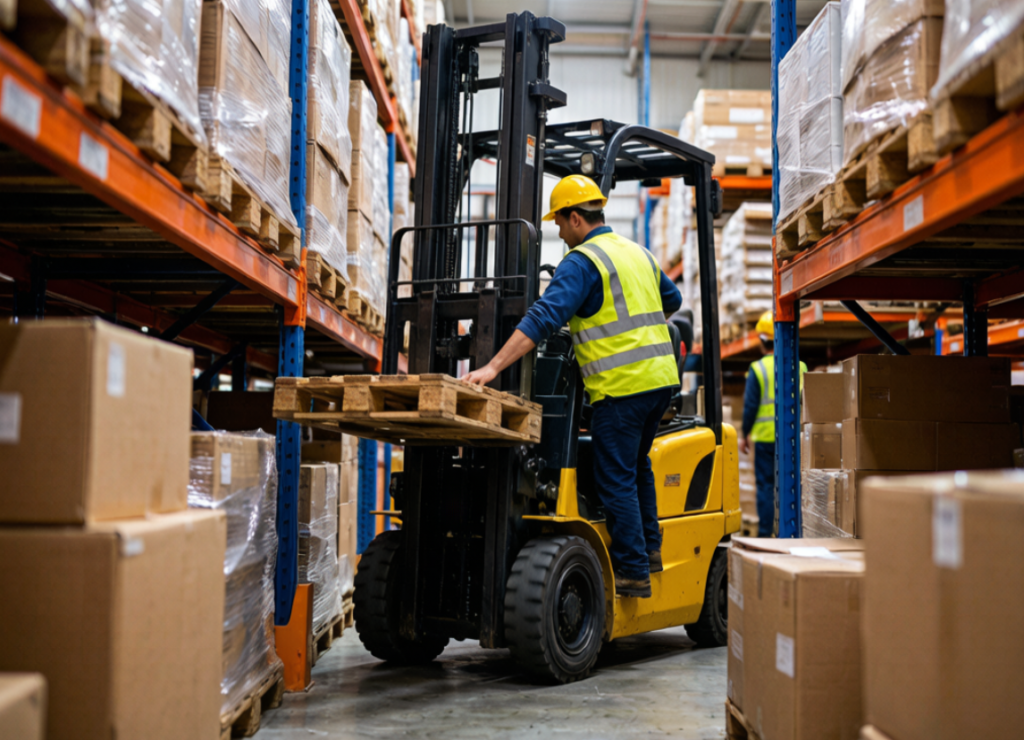
Selective Pallet Racking in Detail
Selective racking is the default choice for 85% of warehouses because it provides unrestricted access to every pallet. Each row of rack is separated by an aisle, allowing forklifts to reach any pallet directly. No pallet is blocked by another.
How it works: Pallets are stored one deep on beam levels. The forklift enters the aisle, lifts to the appropriate beam level, and deposits or retrieves the pallet. Storage depth is always 1 pallet. Aisle width typically 8-12 feet.
Key specs: 100% selectivity, FIFO compatible, 8-12 ft aisles, ~1 pallet per 30-40 sq ft of warehouse space including aisles. Best for: High SKU counts, fast-moving inventory, diverse product sizes, and operations requiring FIFO rotation.
Drive-In Racking in Detail
Drive-in racking (also called drive-through racking) eliminates aisles between rows by allowing the forklift to drive directly into the rack structure. Pallets sit on horizontal rails or load beams that run the full depth of the structure. The forklift enters from one end, places pallets on the rails, and retrieves them from the same end (LIFO).
Density advantage: Drive-in racking can increase storage density by 60-80% over selective racking by eliminating aisles. A 10,000 sq ft warehouse using selective rack stores ~250 pallets. The same space with drive-in rack can store ~400-450 pallets.
Key specs: LIFO only (unless drive-through configuration), 3-10 pallets deep, 60-80% higher density, requires more skilled forklift operators. Best for: Low SKU counts (<100), high volume per SKU, uniform pallet sizes, bulk raw materials.
Head-to-Head Comparison Table
| Factor | Selective Rack | Drive-In Rack |
|---|---|---|
| Pallet accessibility | 100% (any pallet, any time) | Only end pallet (LIFO sequence) |
| Storage density | Baseline (1x) | 1.6–1.8x (60-80% higher) |
| FIFO compatibility | Yes | No (unless drive-through) |
| SKU capacity | High (unlimited) | Low (<100 ideal) |
| Forklift skill required | Basic | Advanced (driving inside rack) |
| Cost per pallet position | Lower (<3 pallets deep) | Lower (>3 pallets deep) |
| Building column impact | Moderate | High (interrupts deep lanes) |
| Ideal rotation pattern | FIFO, any pattern | LIFO, bulk storage |
Storage Density Analysis
The real decision factor is often density. Consider a 50,000 sq ft warehouse with 30 ft clear height:
- Selective racking: ~1,200 pallet positions (standard 4 pallet width bays, 5 levels, 10 ft aisles)
- Drive-in racking (4 deep): ~2,100 pallet positions (same area, 4 pallets deep, one access aisle per block)
- Drive-in racking (6 deep): ~2,600 pallet positions (6 pallets deep, even fewer aisles)
The Material Handling Institute (MHI) provides density calculators for comparing rack configurations.
Cost Per Pallet Position
Selective racking costs less per position for shallow storage. However, as depth increases, drive-in racking becomes more cost-effective:
- Selective: ~$30-45 per pallet position (racking + installation)
- Drive-in (4 deep): ~$35-55 per pallet position
- Drive-in (6 deep): ~$30-45 per pallet position
At 6 deep, drive-in racking’s cost per position matches selective — while delivering significantly more positions in the same footprint.
Forklift Requirements
Selective racking requires standard counterbalance or reach trucks with basic operator training. Drive-in racking demands more: narrow aisle reach trucks or stand-up counterbalance trucks, operators trained to work inside rack structures, and guidance systems (rail guides) to prevent rack damage.
Which System for Your Inventory?
Choose selective racking when:
- You have 200+ SKUs
- You need FIFO rotation
- Product sizes vary significantly
- Operators have basic forklift training
- You need frequent access to every pallet
Choose drive-in racking when:
- You have fewer than 100 SKUs with high volume each
- LIFO rotation is acceptable (or you can use drive-through for FIFO)
- Products are uniform in size and palletized
- Warehouse space is at a premium
- You have skilled forklift operators
Hybrid approach: Many large warehouses use selective racking for fast-moving SKUs in the front and drive-in racking for slow-moving bulk storage in the rear. This combines the access advantage of selective with the density advantage of drive-in.
FAQ
What is the main difference?
Selective = 100% access, one pallet deep. Drive-in = high density, multiple pallets deep, LIFO.
Which has higher density?
Drive-in: 60-80% higher density by eliminating aisles between rows.
Which costs more?
Selective at shallow depths. Drive-in becomes comparable or cheaper at 6+ pallets deep.
When to choose selective?
High SKU counts, FIFO required, diverse products, basic forklift operation.
When to choose drive-in?
Low SKU counts, high volume per SKU, LIFO acceptable, space at premium.
Conclusion
The choice between selective and drive-in racking comes down to your inventory profile. Selective racking maximizes flexibility and accessibility. Drive-in racking maximizes density and space utilization. Neither is universally superior — the right choice depends on your specific operation. For most warehouses, a combination of both systems offers the best overall solution.
