
When standard selective racking does not provide enough storage density, push back and flow rack systems offer high-density alternatives. Choosing between them depends on inventory rotation, pallet condition, and budget. ZEOU Metal provides industrial storage solutions including rack systems for warehouse applications.
High-Density Storage Decisions
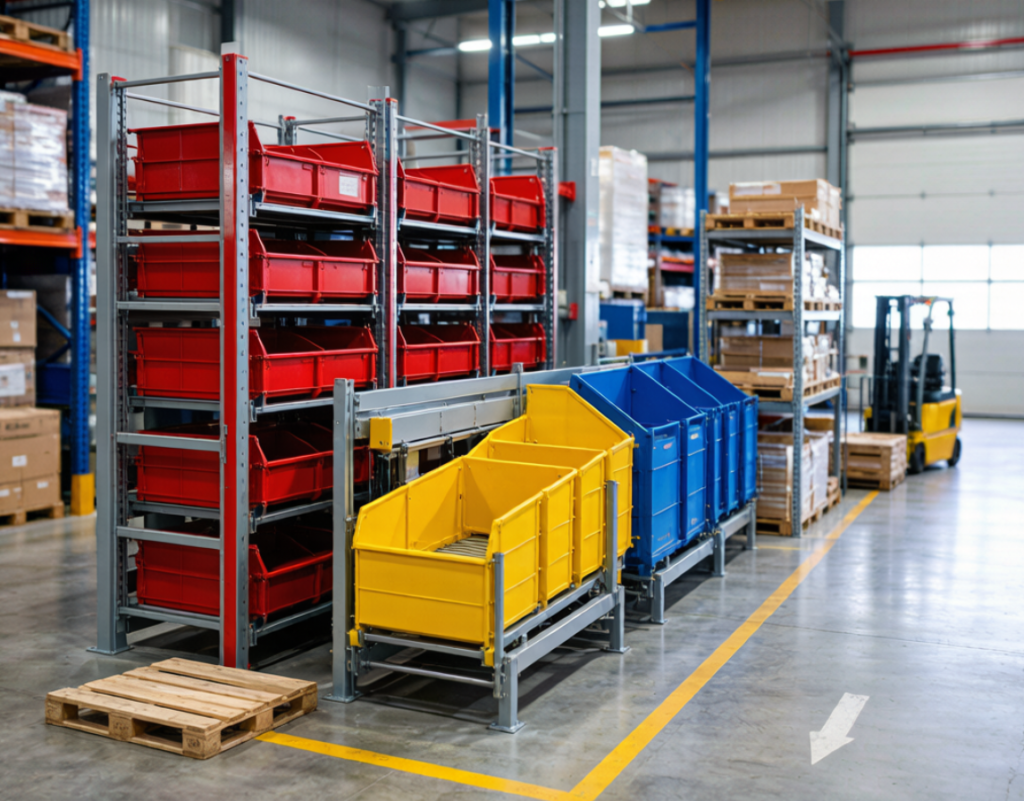
Both push back and flow rack systems increase storage density by reducing the number of access aisles. The Wikipedia article on pallet racking explains the fundamental types. Push back rack uses inclined rails and nested carts that move forward as pallets are loaded. Flow rack uses gravity rollers to move pallets from the loading end to the picking end. Each serves a different inventory management strategy.
Push Back Racking Explained
Push back racking operates on a LIFO (Last-In, First-Out) principle using nested carts on inclined rails: Pallets are loaded from the same side where they are retrieved. Each new pallet pushes the previous pallet back along inclined rails. Depths range from 2 to 4 pallets deep. The system requires no rollers or moving parts beyond the carts — making it mechanically simple and reliable. Push back is ideal for warehouses storing multiple SKUs where each lane holds one SKU. ZEOU offers warehouse storage solutions compatible with high-density rack systems.
Flow Rack Explained
Flow rack (gravity flow rack) uses inclined roller tracks where pallets are loaded at the rear and flow by gravity toward the front picking position. Braking systems control pallet speed to prevent impact. The system operates on FIFO (First-In, First-Out) principle — the first pallet loaded is the first pallet picked. Depths range from 2 to 10+ pallets deep. Flow rack requires quality pallets with consistent bottom boards. Rollers and brakes require periodic maintenance. The OSHA storage rack safety guidelines provide requirements for flow rack installations.
FIFO vs LIFO: The Critical Difference
| Factor | Push Back (LIFO) | Flow Rack (FIFO) |
|---|---|---|
| Inventory rotation | Last in, first out | First in, first out |
| Ideal for | Same-SKU, no expiry | Perishables, date-sensitive |
| Loading side | Same as retrieval | Rear (opposite retrieval) |
| Lane depth | 2-4 pallets | 2-10+ pallets |
Storage Density Comparison
Both systems significantly increase density over selective rack. Push back at 3-deep eliminates approximately 50% of aisles compared to selective rack. Flow rack at 6-deep can achieve 60-70% space savings. The longer the lane depth, the greater the density advantage. Flow rack typically achieves slightly higher density because depths can be greater. However, the density advantage must be weighed against the operational constraints of each system.
Cost per Pallet Position
Push back rack (3-deep): $100-200 per pallet position. Flow rack (roller system): $150-300 per pallet position. Selective rack baseline: $50-100 per position. Flow rack costs more due to the roller tracks, braking systems, and more complex structure. Push back is mechanically simpler and less expensive per position. For depths beyond 4 pallets, flow rack is the only option. For shallow depths (2-4), push back is more economical.
Forklift Requirements
Push back rack: Requires a standard counterbalance forklift with sufficient lift height. No special attachments needed. The operator loads from the aisle and pushes pallets into the lane. Flow rack: Requires a reach truck or forklift with adequate reach for rear loading. Some systems use shuttle carts for loading. The rear-loading requirement means aisles on both sides of the rack are needed — one for loading, one for picking.
Pallet Quality Requirements
Flow rack demands quality pallets in good condition — no broken boards, consistent dimensions, and flat bottom boards. Damaged pallets can jam or cause safety issues in the roller tracks. Push back rack is more forgiving of pallet condition since pallets nest on carts rather than rolling on tracks. If your pallet supply includes mixed-quality pallets, push back may be the more practical choice. ZEOU’s industrial shelving experts can advise on pallet compatibility.
Best Applications
Push back rack: Cold storage, grocery distribution, beverage warehousing, same-SKU bulk storage. Flow rack: Perishable goods, pharmaceutical warehousing, dairy, frozen food, date-sensitive inventory rotation. For facilities handling both FIFO and LIFO SKUs, a combination of both systems may be optimal.
Comparison Table
| Factor | Push Back Rack | Flow Rack |
|---|---|---|
| Inventory rotation | LIFO | FIFO |
| Max lane depth | 2-4 pallets | 2-10+ pallets |
| Cost per position | $100-200 | $150-300 |
| Pallet quality needed | Moderate | High |
| Mechanical complexity | Simple | Moderate |
| Best for | Bulk same-SKU | Date-sensitive goods |
FAQ
What is the difference between push back and flow rack?
Push back uses nested carts on inclined rails for LIFO rotation. Flow rack uses gravity rollers for FIFO rotation. The key difference is inventory rotation method.
Which system provides higher storage density?
Flow rack can achieve higher density due to greater lane depth capacity (up to 10+ pallets vs 4 for push back). Both significantly outperform selective rack.
Does flow rack require special pallets?
Yes. Flow rack requires consistent-quality pallets with flat bottom boards. Damaged pallets can jam the roller tracks and cause operational issues.
Which is cheaper, push back or flow rack?
Push back is typically 20-40% cheaper per pallet position than flow rack due to simpler mechanical design and lower installation costs.
Expert High-Density Storage Advice
Choosing between push back and flow rack? ZEOU Metal provides storage solutions for warehouses of all sizes. Explore our industrial shelving range or contact our team for a free consultation.
