

Pallet racking is the backbone of any efficient warehouse. It determines how much you can store, how quickly you can access inventory, and how safely your facility operates. Yet many warehouse managers choose a racking system based on price alone — without understanding the tradeoffs between different types.
This guide covers everything from the four main racking types to component specifications and load capacity calculations. For wire shelving solutions that complement your racking system, see ZEOU warehouse shelving.
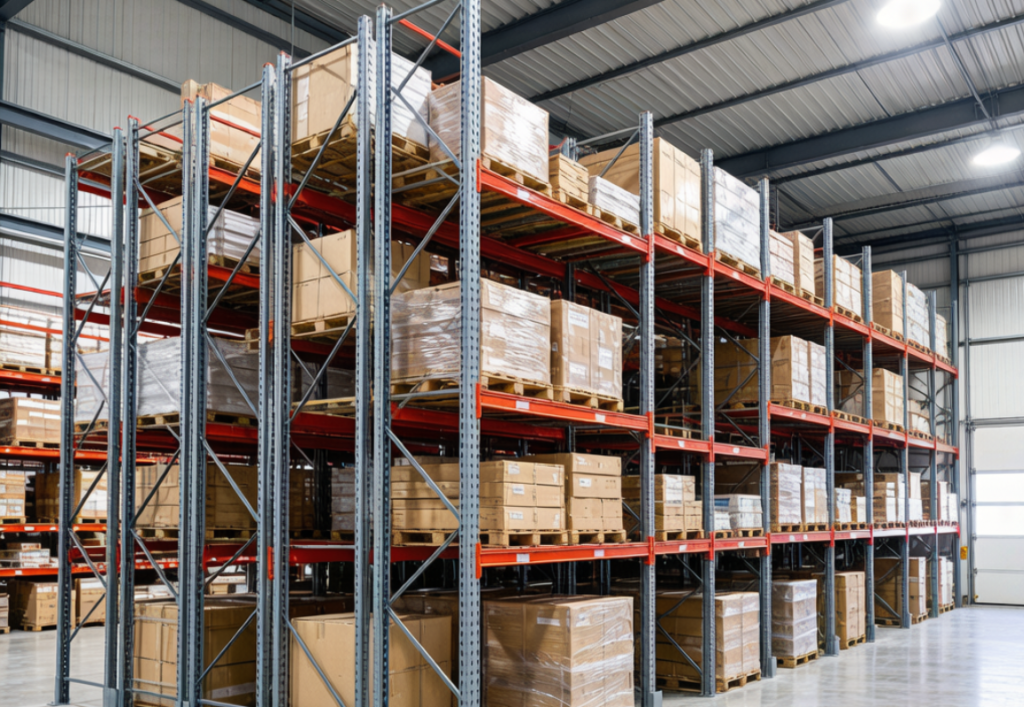
Introduction to Pallet Racking Systems
Pallet racking is a material handling storage system designed to store palletized materials on horizontal beams supported by vertical upright frames. Unlike standard shelving, pallet racking is engineered for heavy loads — typically ranging from 2,000 to 6,000 pounds per pallet position.
Fundamental distinction: All pallet racking systems balance three competing priorities — selectivity (access to each pallet), density (pallets stored per square foot), and cost. No single system maximizes all three. The best choice depends on your inventory profile.
Modern pallet racking is governed by MHI (Material Handling Institute) standards and the Rack Manufacturers Institute (RMI) design specifications.
Selective Pallet Racking
Selective pallet racking is the most common type worldwide, accounting for approximately 85% of installed rack systems. In selective racking, each pallet is stored one deep on beams, with an aisle in front of every row. This provides 100% accessibility to every pallet.
Advantages: Unlimited selectivity, easy FIFO inventory management, fast picking (single-deep access), simple forklift operation, lowest equipment cost per position. Disadvantages: Lowest storage density (only 1 pallet deep), requires extensive aisle space.
Best for: Warehouses with high SKU counts, fast-moving inventory, diverse product sizes, and operations requiring FIFO rotation. Ideal for e-commerce fulfillment, third-party logistics, and retail distribution.
Drive-In / Drive-Through Racking
Drive-in racking eliminates aisles between racks by allowing forklifts to drive directly into the rack structure. Pallets are stored multiple deep (typically 3–10 pallets deep) on rails or beams running the depth of the structure.
Key tradeoff: Drive-in racking can increase storage density by 60–80% compared to selective racking, at the cost of restricting access to LIFO (last-in, first-out) inventory rotation. Drive-through racking (with entry and exit on opposite sides) enables FIFO.
Best for: Low-SKU, high-volume products such as bulk beverages, boxed goods, and raw materials. Common in cold storage, food & beverage, and manufacturing warehouses.
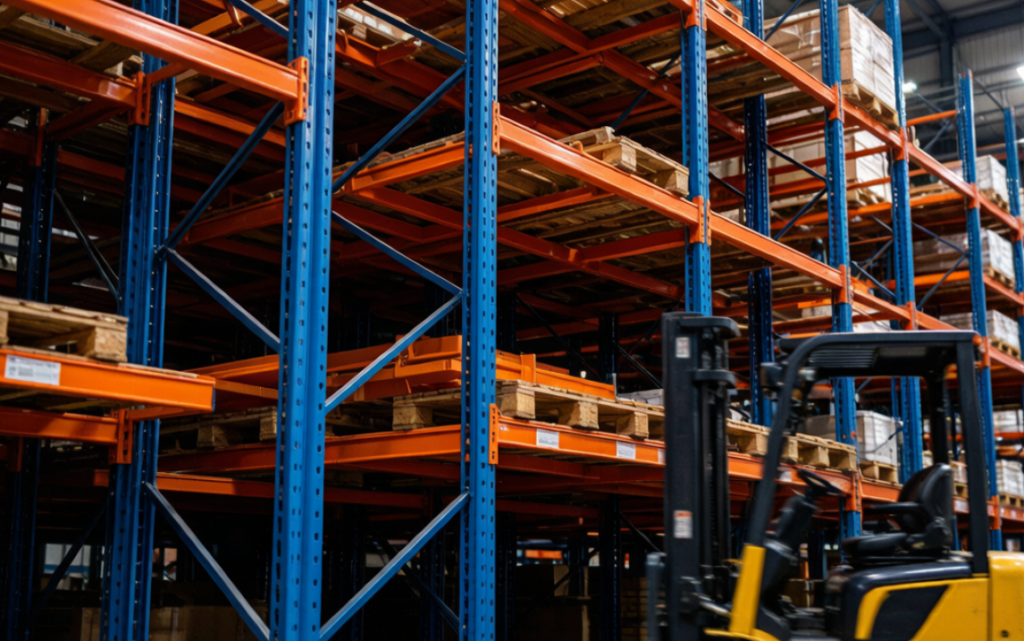
Push-Back Racking
Push-back racking uses nested carts or pallet carriers on inclined rails to store pallets 2–4 deep. When a new pallet is loaded from the front, it pushes existing pallets back. When the front pallet is removed, remaining pallets slide forward by gravity.
Advantages: Higher density than selective (2–4 deep), faster pallet access than drive-in, good selectivity for medium-SKU operations. Disadvantages: Higher cost per position than selective or drive-in, slightly more complex maintenance required.
Pallet Flow / Gravity Flow Racking
Pallet flow racking (also called gravity flow rack) uses inclined roller tracks with speed controllers. Pallets are loaded at the rear and flow by gravity to the front pick face. This provides true FIFO (first-in, first-out) rotation.
Key advantage: Pallet flow is the only high-density system that provides automatic FIFO rotation — making it the only choice for perishable goods, pharmaceuticals, and time-sensitive inventory. OSHA guidelines for warehousing recommend FIFO systems for products with expiration dates.
Rack Components Explained
Every pallet rack system consists of these standard components:
| Component | Function | Key Specifications |
|---|---|---|
| Upright frame | Vertical support structure | Height, depth, column profile, gauge (14-10ga) |
| Step beam | Horizontal load support | Length, height (3-5″), gauge, load rating per pair |
| Beam connector | Attaches beam to upright | Integral safety lock required by RMI |
| Wire mesh deck | Pallet support surface | Gauge, channel vs square edge, load capacity |
| Row spacer | Connects back-to-back rows | Length, gauge, seismic rating |
| Column guard | Protects upright from forklift impact | Height, material (steel/polyurethane), mounting |
| Base plate | Distributes load to floor | Size, anchor hole pattern |
For wire mesh decking specifically, see ZEOU wire shelving products.
Load Capacities & How to Read Specs
Understanding rack load specifications is critical for safety. The ANSI MH16.1 standard governs the design and testing of industrial steel storage racks in the United States.
Beam load capacity: Published as pounds per pair of beams at a given length. Example: a 96″ beam pair rated at 5,000 lbs means each pair can safely support 5,000 lbs evenly distributed across both beams. Frame load capacity: The total weight the upright frame can support (all beam levels combined). A typical 16-foot frame with 3 beam levels may be rated for 40,000 lbs total.
Factors reducing capacity: Deflection limits (typically L/180 for rack beams), seismic zone requirements, impact damage, corrosion, and non-uniform load distribution.
Critical safety note: Never exceed the published load capacity. Rack overloads are responsible for approximately 35% of rack collapses. Always factor in a safety margin of 1.5:1 for dynamic loads and forklift impact.
How to Choose the Right System
| Your Inventory Profile | Recommended System | Rationale |
|---|---|---|
| 1,000+ SKUs, fast-moving | Selective rack | 100% accessibility, FIFO, fast picking |
| 50–200 SKUs, high volume | Drive-in rack | Maximizes density, LIFO acceptable |
| 200–500 SKUs, medium turnover | Push-back rack | Good density + reasonable selectivity |
| Perishable goods, date-sensitive | Pallet flow rack | Automatic FIFO rotation |
| Mixed sizes, irregular loads | Adjustable selective rack | Flexible beam positioning |
Safety Standards & Compliance
Warehouse racking safety is governed by multiple standards. OSHA 1910.22 requires all storage areas to maintain clear aisles, safe load capacities, and regular inspection schedules. The Rack Manufacturers Institute (RMI) publishes recommended inspection procedures.
Minimum safety requirements: Daily visual inspection of impact damage. Annual professional inspection. Replacement of damaged components (not repair). Permanent load capacity labels on every row. Column guards on all aisle-facing uprights. Floor anchors installed per specification.
Frequently Asked Questions
What are the main pallet racking types?
Selective, drive-in, push-back, and flow rack. Each balances selectivity, density, and cost differently.
What are the components?
Upright frames, step beams, beam connectors, wire mesh decking, row spacers, column guards, and floor anchors.
How do I read load capacity specs?
Beam load = lbs per pair at a given length. Frame load = total weight on the upright. Both must be verified.
What is the difference between selective and drive-in?
Selective = 100% access, 1 pallet deep. Drive-in = high density, 3-10 pallets deep, LIFO only.
What safety standards apply?
ANSI MH16.1, RMI design specifications, and OSHA 1910.22 for storage area safety and inspection.
Conclusion
Choosing the right pallet racking system requires understanding your inventory profile, space constraints, and operational priorities. Selective racking offers maximum flexibility for high-SKU operations. Drive-in and push-back systems boost density for volume storage. Pallet flow rack provides essential FIFO rotation for time-sensitive goods.
Whichever system you choose, invest in quality components, adhere to load capacity specifications, and maintain a regular inspection schedule. Your racking system is the structure your entire warehouse depends on.
