

Boltless and bolted shelving represent two different approaches to shelf connection. Each has advantages depending on the application. ZEOU Metal manufactures both boltless wire shelving and bolted shelving for commercial and industrial use.
Two Connection Methods
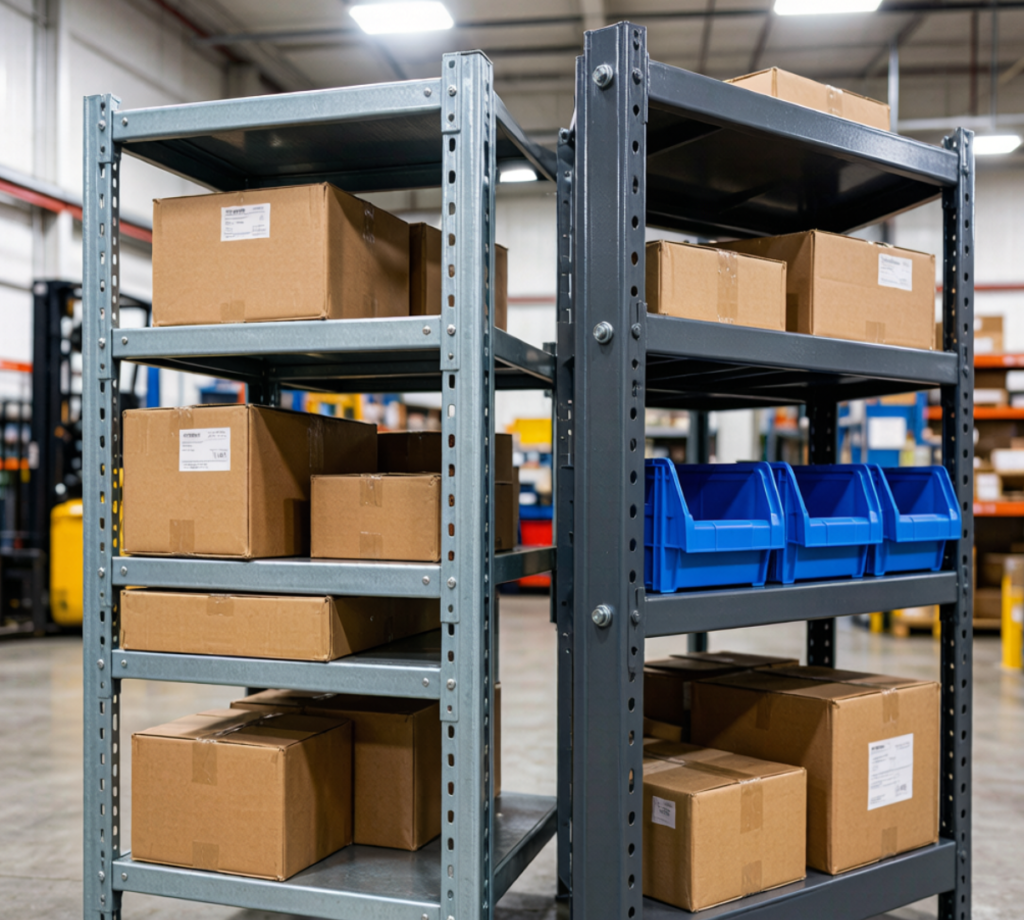
The connection between shelf beams and uprights is one of the most fundamental design decisions in shelving. The Wikipedia article on shelving describes different construction methods. Boltless shelving uses rivets or tear-drop shaped clips that lock into keyhole slots. Bolted shelving uses nuts and bolts for a rigid connection. Each offers different trade-offs in assembly speed, strength, and adjustability.
Boltless Shelving Explained
Boltless shelving uses rivet or clip connections that snap into slotted uprights — no tools required for assembly: Shelves simply clip into position at any height. Adjustments take seconds. Assembly is intuitive and requires no specialized labor. Boltless systems are ideal for facilities that frequently reconfigure shelving layouts. Most boltless systems offer rivet connections (tear-drop or keyhole patterns) combining speed with adequate strength. Boltless wire shelving is popular in commercial kitchens, retail backrooms, and light industrial storage. ZEOU’s commercial shelving includes premium boltless systems.
Bolted Shelving Explained
Bolted shelving uses steel bolts through uprights and beam connectors for structural connections. Each connection requires tightening with tools. Bolted connections provide the highest rigidity and load capacity. They are less likely to dislodge under dynamic loads. Bolted shelving is the standard for heavy industrial storage where loads exceed 1,500 lbs per shelf. Assembly takes longer and requires tools and training. Once assembled, bolted shelving is less likely to be reconfigured.
Assembly Comparison
| Factor | Boltless | Bolted |
|---|---|---|
| Tools required | None | Wrench, socket set |
| Time per bay | 5-10 minutes | 15-30 minutes |
| Skill required | Minimal | Basic mechanical |
| Reconfiguration | Easy, tool-free | Labor-intensive |
Structural Rigidity
Bolted connections provide 20-40% higher rigidity than boltless connections under equivalent loads. At loads under 1,000 lbs per shelf, the difference is negligible. At loads above 1,500 lbs, bolted connections provide noticeably better stability. For seismic areas or vibration environments, bolted shelving is recommended. Boltless systems can be enhanced with sway braces and back panels to improve rigidity.
Adjustability
Boltless shelving offers tool-free adjustability — shelf positions change in seconds by lifting and repositioning. Bolted shelving requires unbolting, repositioning, and retightening — taking 10-15 minutes per shelf. For facilities that change product mix frequently, boltless offers significant labor savings. For stable storage configurations, the adjustability difference may not justify the strength trade-off.
Load Capacity
Boltless shelving: 500-1,500 lbs per shelf depending on gauge and span. Bolted shelving: 1,000-4,000+ lbs per shelf. For light to medium loads, boltless is adequate. For heavy industrial loads exceeding 1,500 lbs, bolted is the appropriate choice. The OSHA storage regulations require load ratings to be posted on industrial shelving regardless of connection type.
Cost Comparison
Boltless shelving: $50-150 per shelf unit. Bolted shelving: $80-250 per shelf unit. Bolted shelving costs 30-60% more due to heavier steel, additional hardware, and longer assembly time. When labor costs for assembly are included, boltless has a significant advantage for installations requiring multiple units. For heavy-duty applications where bolted is the only safe option, the higher cost is justified.
Best Applications
Boltless: Dry storage, retail backrooms, food service shelving, warehouse light storage, office storage, medical supply storage. Bolted: Heavy industrial storage, tool room shelving, manufacturing material storage, warehouse heavy-load areas, seismic zones. ZEOU offers both types with solutions for every load requirement.
Comparison Table
| Factor | Boltless Shelving | Bolted Shelving |
|---|---|---|
| Assembly time | 5-10 min per bay | 15-30 min per bay |
| Load capacity | 500-1,500 lbs | 1,000-4,000+ lbs |
| Rigidity | Good | Excellent |
| Adjustability | Tool-free, instant | Tools required |
| Cost per unit | $50-150 | $80-250 |
| Best for | Light to medium loads | Heavy industrial loads |
FAQ
What is the difference between boltless and bolted shelving?
Boltless shelving uses clip-in or rivet connections requiring no tools. Bolted shelving uses nuts and bolts for higher rigidity and load capacity.
Which is stronger, boltless or bolted shelving?
Bolted shelving is 20-40% stronger and more rigid under equivalent loads. Boltless is adequate for loads under 1,500 lbs per shelf.
Can boltless shelving be adjusted?
Yes. Boltless shelves can be repositioned in seconds without tools — one of its main advantages over bolted systems.
Is boltless shelving safe for heavy loads?
Yes, within its rated capacity. Always verify the load rating and do not exceed the manufacturer’s specified maximum weight per shelf.
The Right Shelving for Your Needs
ZEOU Metal offers both boltless and bolted shelving systems for every storage application. Explore our shelving range or contact our team for selection assistance.
