

Contents
Rack accessories are the difference between a storage system and a safe, compliant storage system: row spacers separate back-to-back rows, column guards absorb forklift impacts, beam locks prevent accidental beam dislodgement, and anchors secure the frame to the floor. Each is inexpensive; together they prevent costly damage and accidents.
The Short Answer
Racking is sold as a structural kit, but the accessories are what make it safe, compliant, and durable. Row spacers tie back-to-back rack rows together for stability; column guards protect uprights from forklift impact; beam safety locks keep beams seated; back panels and pallet supports prevent product falling through; floor anchors secure the frame; and aisle markers keep equipment in the right lanes. Skimping on accessories saves a few dollars per position today and costs thousands in damage and liability tomorrow. Most insurers and the RMI (ANSI MH16.1) guidelines expect these components to be installed and maintained, and OSHA general workplace-safety rules apply to their condition.
Why Accessories Matter
Think of accessories as the safety systems of the rack — like seat belts in a car. They protect both the material handling operation and the people in it. The rack structure carries the load; accessories protect the structure, the people, and the product. A rack without beam locks can have a beam kicked out by a misaligned pallet; without column guards, the first forklift impact starts the damage cycle; without row spacers, back-to-back racks can sway or topple. The cost of a full accessory set is typically 3-8% of the rack investment — trivial compared with the cost of one incident.
Row Spacers
Row spacers connect back-to-back rack rows at the top, maintaining the required gap and transferring sway loads between frames. They prevent rack rows from toppling outward and keep the flue space consistent — a fire-safety requirement in many codes, since the gap allows sprinkler water to reach the storage. Spacers are usually bolt-on steel struts installed across the top of adjacent frames. They are required wherever rows sit back-to-back with a narrow gap, and their presence is often checked during fire and insurance inspections.
Column Guards & Post Protectors
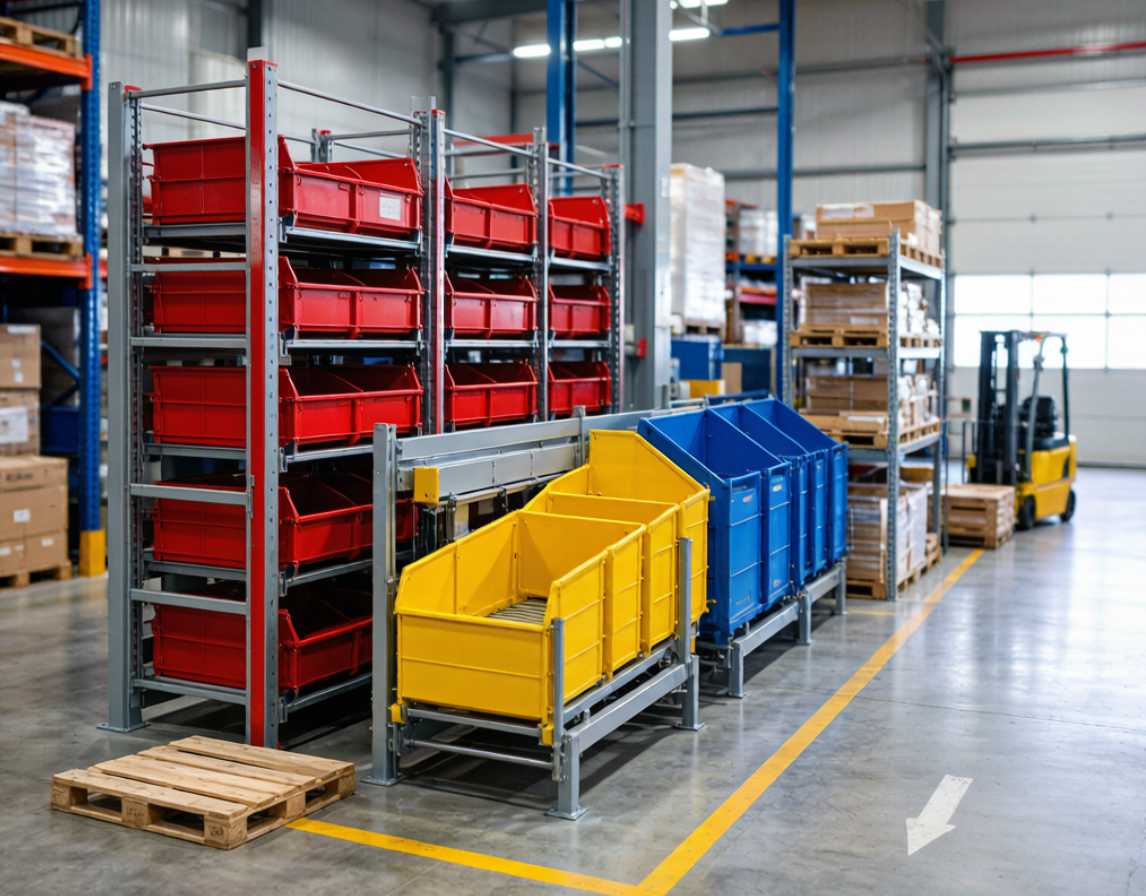
Column guards are the most visible and most valuable accessory: steel shields anchored around upright columns in traffic paths. They absorb the kinetic energy of a forklift impact so the column does not — protecting the rack’s structural capacity and the people nearby. Available in bolt-on and floor-mount styles, they are placed on the aisle-facing side of columns, at bay corners, and anywhere pallet jacks or forklifts turn. Replace a guard after a hard hit even if it looks OK — its job is to sacrifice itself. Painted impact-resistant guards (often yellow or orange) also make columns more visible.
Back Panels & Rear Protection
Back panels (solid or wire mesh) close off the rear of a rack bay, preventing product from being pushed through and falling into an aisle or work area. They are required wherever the rack backs onto an aisle, a walkway, or a workspace — and where items can be pushed out during loading. Options include solid steel panels (maximum containment, also serve as fire baffles in some configurations) and wire mesh panels (visibility and light penetration). For long or unstable loads, adding rear support bars prevents the pallet from tipping backward.
Beam Safety Locks
Check locks during every inspection: they are cheap, easily replaced, and their absence is an immediate safety finding. Some rack systems use built-in gravity locks; older racks may need retrofit locks, which manufacturers supply. Never operate a rack with missing or broken beam locks.
Aisle Markers & Floor Guidance
Aisle markers — painted lines, floor tape, or raised guides — keep forklifts and pallet jacks aligned and within safe clearance. They prevent the most common rack killer: misaligned entry into an aisle, which scrapes columns and drops pallets. Mark the travel lane, the rack face, and pedestrian walkways clearly. Floor-mounted guidance rails (angle steel) add a physical stop that alerts the operator before contact. In narrow-aisle and VNA facilities, guidance systems are essential to protect both rack and machine.
Pallet Supports & Wire Decks
Pallet supports are steel bars spanning between beams that prevent pallets from sagging or falling through gaps; wire mesh decks provide a continuous load surface. They are critical for pallets with broken boards, damaged pallets, or loads smaller than the beam opening — and they prevent debris and product from falling into the aisle below. Wire mesh decking also allows sprinkler water to pass through and keeps the rack clean. Choose channel or square-edge decks based on the pallet type and required load.
Shims & Floor Anchors
Floor anchors bolt rack frames to the concrete slab, preventing the rack from tipping during seismic events or heavy impacts. Anchoring is not optional — ANSI/RMI standards require frames to be anchored to a floor capable of resisting the loads. Shims (steel plates) level the frame on uneven floors before anchoring, ensuring the column base is fully supported and the frame stands plumb. Use the manufacturer’s anchor specification (type, size, depth) and verify pull-out capacity; re-torque after settling. On coated or sealed floors, protect anchors from corrosion.
FAQ
Are rack accessories required or optional?
Most are effectively required for safe, compliant operation: beam locks and floor anchors are safety-critical and expected by standards and insurers; column guards are strongly recommended in traffic areas; row spacers are required for back-to-back rows.
What is the purpose of a row spacer?
Row spacers connect back-to-back rack rows at the top, maintaining the required flue gap and transferring sway loads, preventing the rows from toppling outward and ensuring sprinkler access.
Do I need beam safety locks?
Yes. Beam safety locks prevent beams from being dislodged by misaligned pallets — one of the most common causes of rack collapse. Every beam connection should have a functioning lock.
Where should column guards be installed?
On every upright in forklift and pallet jack traffic paths — aisle-facing columns, bay corners, and near turning zones. Guards absorb impacts that would otherwise damage the structural column.
Can racking be installed without anchoring?
Anchoring is required by ANSI/RMI standards to prevent tipping. Unanchored racks are a significant safety and liability risk and are not compliant with standard practice.
Complete Rack Accessories from ZEOU
Sources: RMI / ANSI MH16.1.
