

Electric pallet jacks and forklifts are two of the most common material handling machines in warehouses. Each serves distinct roles based on lift height, load weight, and aisle width. ZEOU Metal provides warehouse storage solutions compatible with both types of equipment.
Two Essential Machines
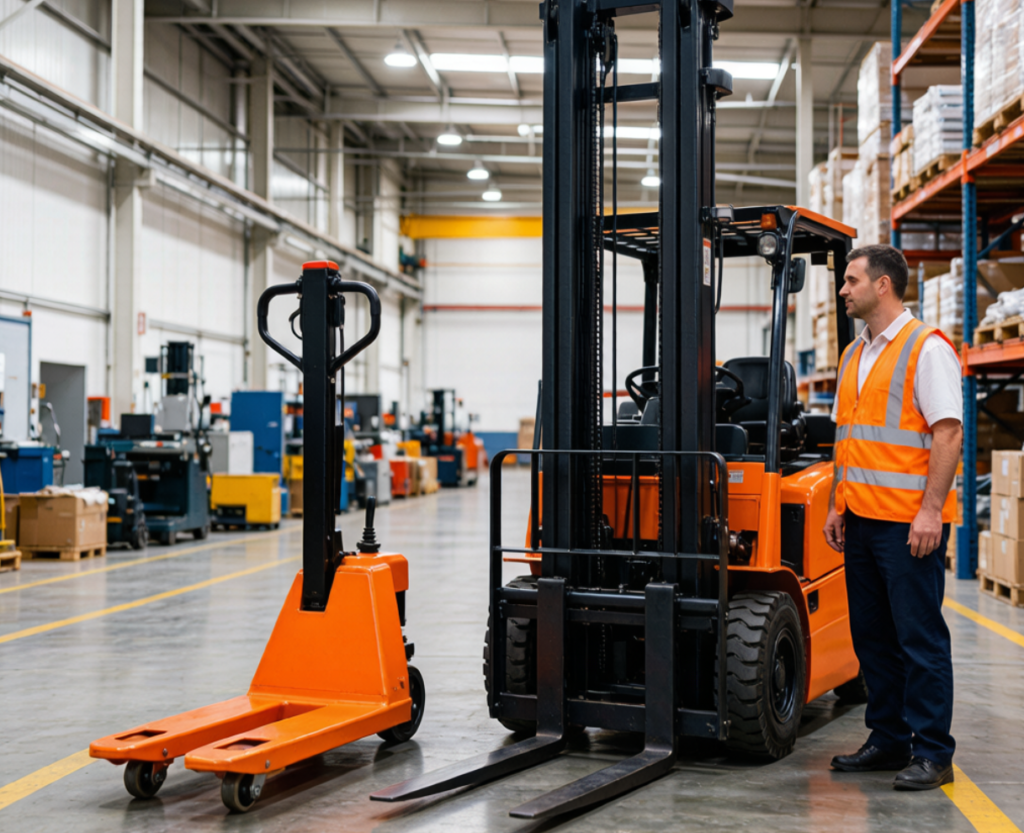
Electric pallet jacks (walkie-rider pallet trucks) and forklifts (counterbalance lift trucks) are both used for moving palletized loads. The Wikipedia article on pallet jacks and the forklift article provide technical background. The choice between them depends on lift height requirements, available aisle width, load weight, and budget constraints.
Electric Pallet Jack Overview
Electric pallet jacks are designed for horizontal transport of pallets at ground level — ideal for loading docks, shipping areas, and order picking: Lift height typically 3-6 inches (floor level only). Capacities: 4,000-8,000 lbs. Operator walks behind or rides on the unit. Zero turning radius for exceptional maneuverability in tight aisles. Battery-powered with 6-8 hour run time. Lower acquisition cost than forklifts. Electric pallet jacks are the most efficient tool for moving pallets short distances on flat surfaces.
Forklift Overview
Forklifts (counterbalance) are designed for lifting pallets to elevated rack positions. Lift heights: 10-20+ feet standard, up to 40 feet for specialized models. Capacities: 3,000-10,000+ lbs (standard). Require significantly more aisle width for turning (12-15 feet for standard counterbalance). Internal combustion or electric powered. Forklifts are essential for any warehouse using rack storage above ground level. The OSHA forklift safety requirements mandate operator certification for all forklift operators.
Maneuverability
| Factor | Electric Pallet Jack | Forklift |
|---|---|---|
| Turning radius | Zero (pivot on spot) | 8-15 ft |
| Aisle width needed | 5-7 ft | 10-15 ft |
| Dock to stock | Excellent | Good |
| Loading trailers | Excellent | Good (needs room) |
Lift Height
This is the most critical differentiator. Electric pallet jacks lift only enough to clear the floor (3-6 inches). They cannot place pallets into rack storage above ground level. Forklifts lift to standard rack heights (10-20 feet) and reach trucks can lift to 40 feet. If your storage requires any vertical pallet placement above floor level, you need a forklift or reach truck. For horizontal transport only, electric pallet jacks are more efficient.
Load Capacity
Electric pallet jack: 4,000-8,000 lbs standard. Forklift: 3,000-10,000 lbs standard, up to 50,000 lbs for heavy-duty models. For most pallet loads (2,000-3,000 lbs), both machines have adequate capacity. For heavy loads exceeding 6,000 lbs, industrial forklifts are required. For narrow-aisle operations, very narrow aisle (VNA) trucks lift to 40 feet and carry 2,000-4,000 lbs.
Operator Training
Electric pallet jack: Minimal training required (typically 1-2 hours). No formal certification required by OSHA (though employer training is recommended). Forklift: OSHA-required formal training and certification. The OSHA 1910.178 standard specifies classroom training, practical training, and evaluation every three years. Forklift certification costs more and takes longer but is legally required.
Cost Analysis
Electric pallet jack: $3,000-8,000 new. Forklift (electric): $20,000-50,000 new. Forklift (internal combustion): $15,000-35,000. Annual maintenance: pallet jack $500-1,000, forklift $2,000-5,000. Over a 10-year lifecycle, an electric pallet jack costs approximately $10,000-20,000 total. A forklift costs approximately $40,000-80,000 total. For operations requiring only horizontal transport, electric pallet jacks offer dramatically lower costs.
Application Guide
Use electric pallet jack for: loading/unloading trailers, ground-level transport, cross-docking, order picking (with pallet jack picking), shipping staging. Use forklift for: placing pallets into rack storage above ground, stacking pallets, unloading stacked containers, handling heavy or oversized loads. Most warehouses need both — electric pallet jacks for horizontal movement and forklifts for vertical storage. ZEOU’s industrial shelving is designed for efficient forklift and pallet jack access.
Comparison Table
| Factor | Electric Pallet Jack | Forklift |
|---|---|---|
| Lift height | 3-6 inches | 10-40 ft |
| Load capacity | 4,000-8,000 lbs | 3,000-10,000+ lbs |
| Aisle width needed | 5-7 ft | 10-15 ft |
| Operator certification | Not required | OSHA required |
| Purchase cost | $3,000-8,000 | $15,000-50,000 |
| Best for | Horizontal transport | Vertical storage |
FAQ
Can an electric pallet jack replace a forklift?
No. Electric pallet jacks cannot lift pallets above floor level. Any warehouse with rack storage needs forklifts or reach trucks for vertical pallet placement.
Do electric pallet jacks require OSHA certification?
No. Electric pallet jacks are not covered by the OSHA forklift certification requirement. Employer training is still recommended for safety.
Which is more maneuverable in tight spaces?
Electric pallet jacks are significantly more maneuverable with zero turning radius and operate in aisles as narrow as 5-7 feet.
What is the total cost difference?
Over 10 years, an electric pallet jack costs $10,000-20,000 total. A forklift costs $40,000-80,000. Pallet jacks are much more economical for horizontal moves.
Storage Solutions for Every Warehouse
ZEOU Metal provides storage systems optimized for both pallet jack and forklift operations. Explore our solutions or contact us for a layout review.
