

If you’re planning storage for a warehouse, restaurant, or retail store, one of the first practical questions is:
How much weight can commercial shelving actually hold?
Many buyers focus on shelf size or price, but the factor that really determines whether shelving will work long-term is load capacity.
In real projects, the required load capacity can vary a lot depending on the type of business. For example:
A restaurant kitchen may store food containers and supplies
An e-commerce warehouse may store dozens of cartons per shelf
A hardware warehouse may store heavy tools or parts
Even though all of these use “commercial shelving,” the weight requirements can be very different.
Typical Weight Capacity of Commercial Shelving
In most commercial environments, shelving is usually designed within the following load ranges.
| Shelving Type | Load Capacity Per Shelf |
|---|---|
| Light-duty shelving | 100–150 kg |
| Medium-duty shelving | 200–350 kg |
| Heavy-duty shelving | 350–500 kg |
These numbers represent typical industry ranges, although the exact capacity depends on shelf size, steel thickness, and structural design.
Warehouse Example: E-commerce Storage
Many e-commerce warehouses use wire shelving to store cartons and inventory.
A common shelf size in warehouses is:
48″ × 18″ wire shelf
If each carton weighs around 10 kg, one shelf may hold:
20–25 cartons
That brings the total load to around 200–250 kg.
Most commercial wire shelving systems are designed to handle that range comfortably, since many are rated for 250 kg per shelf when weight is evenly distributed.

Restaurant Kitchen Example
In restaurant kitchens, shelving is used differently.
Typical items stored on kitchen shelves include:
Rice bags
Cooking oil containers
Ingredient boxes
Food containers
For example:
One rice bag: about 25 kg
One oil container: about 20 kg
If a shelf holds:
4 rice bags + 4 oil containers
The total weight is roughly 180 kg.
This is why many commercial kitchens use stainless steel shelving or chrome wire shelving, which offers both durability and adequate load capacity.
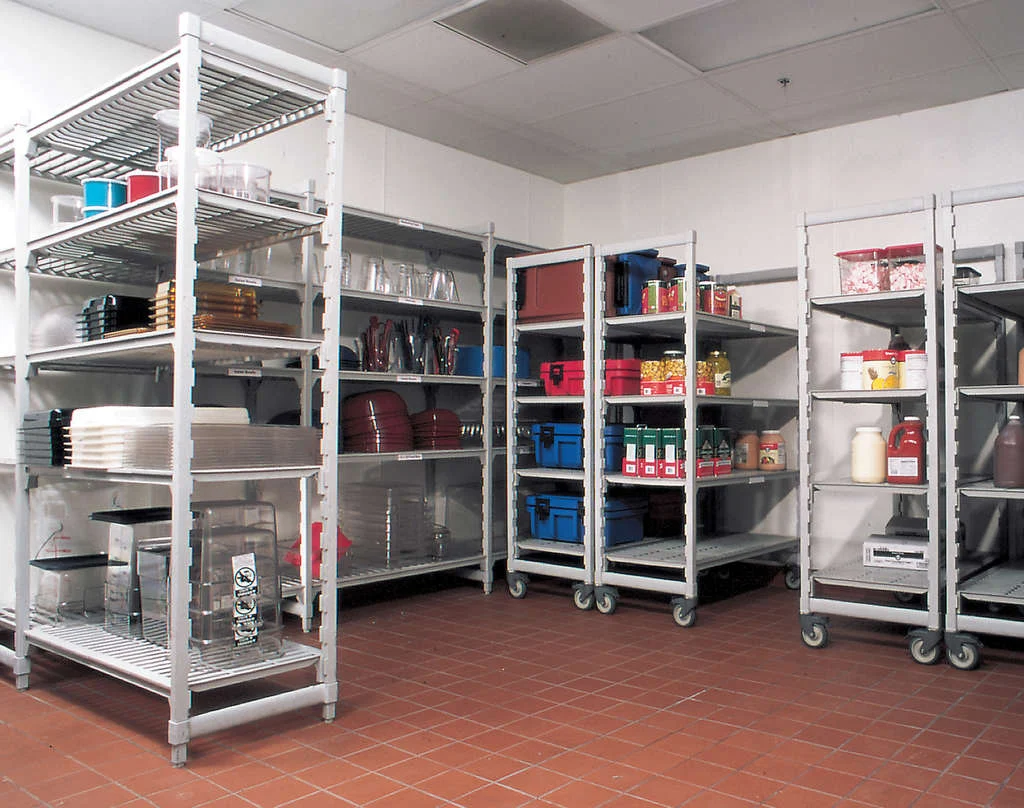
Retail Stockroom Example
Retail stockrooms often use shelving in tighter spaces, and shelves may be stacked vertically.
In this environment:
Boxes are stored temporarily
Employees frequently pick and restock items
Shelving stability becomes very important
If shelving is too light, it may shake or move during daily use.
For this reason, many stores prefer:
4-post wire shelving
boltless metal shelving
These structures provide better stability for frequent handling.
Factors That Affect Load Capacity
Several structural factors influence how much weight a shelving system can safely hold.
Shelf size
Longer shelves usually have slightly lower load capacity because the weight spans a larger distance.
Steel thickness
Thicker steel materials improve the overall strength of shelving.
Post structure
Stronger vertical posts improve stability and support.
Weight distribution
This detail is often overlooked. Even if a shelf is rated for a certain weight, placing all items on one side can cause bending. Even weight distribution helps maintain structural strength.
A Simple Buying Tip
Many warehouse planners follow a practical rule:
Use only 70–80% of the rated load capacity.
For example:
If a shelf is rated for 300 kg,
a practical working load would be around 200–240 kg.
This provides a safety margin and helps extend the lifespan of the shelving.
Conclusion
Commercial shelving typically supports 100 kg to over 500 kg per shelf, depending on its design, materials, and structure.
For many warehouses, retail stockrooms, and restaurant storage areas, standard wire shelving or metal shelving can easily handle around 200 kg per shelf when weight is evenly distributed.
When choosing shelving, it’s worth paying attention not only to size and price but also to load capacity and structural stability. The right shelving system can support daily operations for years without problems.
FAQ
How much weight can wire shelving hold?
Most commercial wire shelving can support around 250 kg per shelf when weight is evenly distributed.
Can commercial shelving hold heavy equipment?
For heavier equipment, heavy-duty shelving or pallet racking systems are usually more suitable.
Is the weight capacity per shelf or per unit?
Most manufacturers list load capacity per shelf, not the total unit capacity.
Does adding more shelves increase weight capacity?
Adding shelves does not increase the load capacity of each shelf but may improve overall storage efficiency.
Why do some shelves bend over time?
This usually happens when weight is concentrated in one area or exceeds the recommended load capacity.
